The truth about memorizing the Quran fast
Real speed in Hifz is not how many new lines you add today. It's new pages minus the pages you lose. A page you memorize in a day and lose in a month didn't save you time. It cost you the day, plus every day you'll spend relearning it.
A student's story (a composite): Bilal started memorizing at 24 and flew: a page a day, every day. By month six he held 8 juz. Then he'd fix Juz 2 and Juz 5 would go, fix Juz 5 and Juz 2 went again. By month ten he had stopped altogether. "My memory just couldn't handle it," he said. His memory was fine. His maths wasn't.
From The Complete Hifz Mastery System
One page a day with no revision isn't fast. It's speedrunning forgetting. So every method below does one of two things: it gets a page into memory in fewer repetitions, or it makes sure you never have to memorize that page again.
9 ways to memorize the Quran faster (that actually last)
1. Fix your reading before you memorize
You memorize exactly what you say, mistakes included. Read a word wrongly and repeat it twenty times, and you've memorized the mistake. Months later a teacher corrects you, and now you have to unlearn it and learn it again: double the work, and the old mistake comes back under pressure. Fixing your reading first is not a delay. It's the fastest route.
2. Prepare every page for 5–10 minutes
Before you repeat a single line: listen to the page 3 times from a trusted reciter with your finger on every word, read it aloud 3 times from the Mushaf, and read a simple translation once. Use the same slow, clear reciter every day. Your ear learns their rhythm, and the rhythm becomes part of your memory. Ten minutes here saves far more in repetition later.
3. Memorize in small blocks, then train the joins
Work 3–4 ayat at a time: one ayah until it's clean from memory, then the next, then recite the block together. Most people don't freeze in the middle of an ayah. They freeze in the gap between ayat, because the link from one ayah to the next is a separate memory. Say the last few words of one ayah straight into the first words of the next, ten times, as one breath. Full method: how to encode a page.
4. Seal it: 3 clean recitations in a row
Many teachers use 20 repetitions per ayah as a starting point, but the real rule is to count clean recitations, not attempts. A portion is sealed when you can recite all of it from memory 3 times in a row without a single mistake. If you slip, that recitation starts again. Then record it on your phone and check it against the Mushaf.
5. Revise with the Mushaf closed
Reading along while a reciter plays feels like revision, but it trains recognition, not recall. Hifz is recall. Do most repetitions with the Mushaf closed and look only when you're stuck. Every time you pull a line out of memory it gets stronger. Every time you read it off the page, you're only practising reading.
6. Memorize after Fajr, or anchor to a Salah
Across almost every Hifz tradition, new memorization happens after Fajr, when the house is quiet and your mind is rested. If that's impossible, tie your Hifz to whichever Salah fits your day. "After Fajr" survives a new job, a new baby and Ramadan. "At 6:30" doesn't.
7. Recite once more before sleep, and don't trade sleep for lines
Reciting today's portion once more before you sleep is one of the best-placed repetitions of the day, because memories are strengthened during sleep. A tired brain memorizes slowly and forgets fast. If you're exhausted, revise lightly and go to bed.
8. Do your sabqi before your new sabaq, every day
Memory fades fastest right after you learn something. A new page needs to be recited again on day 1, 3, 7, 14 and 30 before it graduates into your long-term revision (manzil). On a day you're short of time, do the sabqi and skip the new lesson. Never the reverse. More on this in the stabilization ladder.
9. Use dead time for preparation
Your commute, a walk, washing up: listen to tomorrow's portion with full attention. It doesn't count as revision, but it makes tomorrow's preparation much faster, so your sitting time goes on memorizing, not decoding.
Want these nine methods laid out step by step, with trackers so you don't have to hold it all in your head? See The Complete Hifz Mastery System.
How much should you memorize a day?
This is where most people lose time: they pick a number from someone else's life. Start here instead:
| Where you are | New memorization per day |
|---|---|
| New to memorizing | 2–5 lines |
| Some experience, good reading | Half a page |
| Experienced, strong routine | About a page |
The test: your daily amount is right if you can seal it today and still recite it cleanly tomorrow morning. If tomorrow is shaky, today was too big. If in doubt, choose the lighter pace. You can always speed up. Slowing down after you've overloaded is much harder.
And every pace comes with a second number: the revision it will need as your Hifz grows. "One juz a month" sounds great until month six, when you hold 6 juz and need revision time you never planned. Work out both numbers with the manzil maths, and see what each pace means for your timeline in how long Hifz really takes.
Your fastest pace is personal
Here's the part no article can do for you. Your fastest pace depends on things only you know: how many minutes you really have after Fajr, how long your commute is, how much you already hold, how strong your reading is, and what's happening in your life this season. Get those wrong and you either crawl, or you sprint into a wall like Bilal.
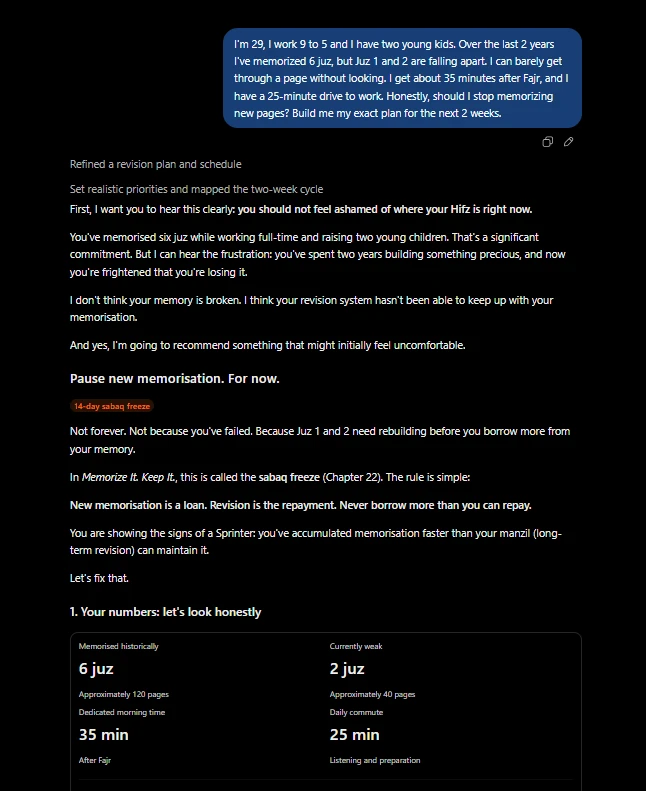
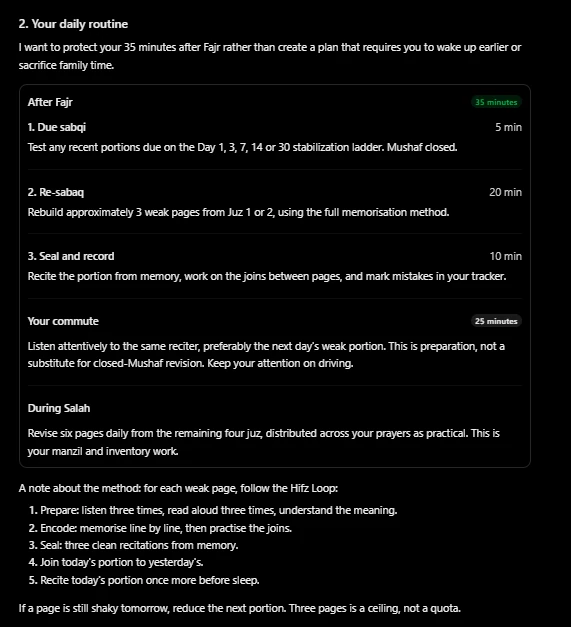
That's why I built AskHafiz, a personal Hifz mentor that runs inside ChatGPT. You tell it where you really are. It asks questions first, then works out your plan from your numbers, on the same method as this article. Here's a real conversation with a working parent who was memorizing fast and losing old juz:
Signs you're going too fast
In the guide this is called the Sprinter: you memorize fast and feel great, then a few months in, old pages start slipping faster than you can fix them. What's really happening is that your new memorization has grown bigger than your revision can support.
- Old juz feel shakier every week, even though you "revise".
- Your revision time keeps growing and you're still losing ground.
- You fix one juz and another one goes.
The fix: a sabaq freeze. Stop new pages until everything you hold is back in rotation and strong, then restart at a smaller daily amount. It feels like going backwards. It's actually the fastest way forward, because you stop paying for the same pages twice. If you've already lost a lot, start with how to come back to your Hifz.
How to memorize faster on a busy schedule
A busy adult can run a real Hifz on about 25 minutes a day plus Salah:
- After Fajr (20 min): sabqi, then new lines.
- Commute: listen to tomorrow's lines.
- In Salah: your manzil portion.
- Evening (5 min): today's lines once more.
- One day a week: no new lines. Revise the whole week instead.
Under 20 minutes a day? Then your normal mode is sabqi plus 2–3 new lines on weekdays, with manzil in Salah and catch-up at the weekend. Progress will be slower. But slow and still going in five years beats fast and stopped in five months. There's a full week laid out in memorizing the Quran as an adult.
If your week doesn't look like that one (shifts, small children, exams, Ramadan), ask AskHafiz to fit the plan to your real schedule. It's there at Fajr or at midnight, in your language.
I memorized the Qur'an between 12 and 14. That was my path, as a full-time young student with hours most adults will never have. Yours will look different, and that's fine. Whatever your pace, the rule that protects it is the same: yesterday's page comes before today's.
Rayan
Frequently asked questions
What is the fastest way to memorize the Quran?
Memorize a page once and never have to memorize it again. In practice that means: fix your reading before you start, memorize in small blocks and train the joins, seal each portion with 3 clean recitations from memory, revise with the Mushaf closed, and always do your sabqi before your new sabaq. Rushing ahead without revision feels fast for a few months, then costs you far more time relearning.
How many pages of the Quran can I memorize in a day?
Less than you think: 2–5 lines if you're new, half a page with some experience and good reading, and a page if you're experienced with a strong routine. Your daily amount is right if you can seal it today and still recite it cleanly tomorrow morning. If tomorrow is shaky, today was too much.
Can I memorize the Quran fast with a full-time job?
You can memorize steadily, and steady is what finishes. A busy adult can run a real Hifz on about 25 minutes a day plus Salah: sabqi and new lines after Fajr, listening to tomorrow's lines on the commute, and manzil inside Salah. Slow and still going in five years beats fast and stopped in five months.
Is there an AI that can make a Quran memorization plan for me?
Yes. AskHafiz is a personal Hifz mentor that runs inside ChatGPT, built on The Complete Hifz Mastery System by Mohammad Rayan. It asks about your time, what you already hold and what keeps slipping, then builds your daily plan and does the revision maths. It never writes Qur'anic Arabic, and it doesn't replace reciting to a teacher.
Why do I forget pages so fast after memorizing them?
Usually because the page was only repeated until it could be said once, then left. Memory fades fastest right after you learn something. A new page needs to be recited again on day 1, 3, 7, 14 and 30 before it's safe in your long-term revision.

I memorized the whole Qur'an by 14 in a Saudi madrasah, more than ten hours a day, through a routine that nearly broke in 2020. I wrote down the methods my sheikhs taught me in The Complete Hifz Mastery System, the system I wish I'd had from day one. Read my story.