Different, not late
| A child usually has… | An adult usually has… |
|---|---|
| Strong raw memory for repetition | Better understanding and focus |
| Lots of free time | Very little free time |
| A teacher every day | No teacher, or one rarely |
| No fear of looking foolish | A real fear of making mistakes in front of others |
Your system has to use your strengths (understanding, discipline, planning) and protect your weaknesses (time, no teacher, fear). And remember: the Prophet ﷺ said the one who struggles with the Quran gets two rewards (Bukhari 4937, Muslim 798). Kids have time. You have understanding. Use it.
The adult system: eight rules
- Fix your reading first. Many adults never finished learning to read properly. A few weeks of reading practice now saves months of unlearning later.
- Set a floor, not a target. A target is what you hope to do on a good day. A floor is what you'll do on your worst day: a few lines of sabaq, or just your sabqi. A small floor survives a bad week. A big target doesn't.
- Anchor to a Salah, not a clock. "After Fajr" survives a new job, a new baby and Ramadan. "At 6:30" doesn't.
- Revision is the appointment. New memorization is the bonus. If you only have 15 minutes today, all 15 go to revision.
- Use dead time for preparation. On your commute or a walk, listen to tomorrow's lesson with full attention. It isn't revision, but it makes tomorrow's preparation much faster.
- Use your Salah as a revision engine. This is where adults find the revision time they think they don't have.
- One human checkpoint a week. Without someone listening, mistakes go unnoticed and harden.
- Write your reduced-mode plan now. Adults don't quit because Hifz is too hard. They quit because life gets busy and there was no smaller plan.
Rule 2 is the one that keeps people going for years.
A real week for a busy adult
| After Fajr (20 min) | Commute | In Salah | Evening (5 min) | |
|---|---|---|---|---|
| Mon–Thu | Sabqi, then new lines | Listen to tomorrow's lines | Manzil portion | Today's lines once |
| Fri | Sabqi + weekly check-in | Listen | Manzil | Today's lines once |
| Sat | Sabqi, new lines, recite to someone | – | Manzil | – |
| Sun | No new lines. Revise the whole week. | – | Manzil | – |
That's about 25 minutes a day of dedicated time, plus Salah.
What if you have under 20 minutes a day?
Then a lighter mode is your normal mode, and that's fine. On weekdays, do sabqi plus 2–3 new lines (about 10 minutes) and keep your manzil in Salah. Use weekends to catch up. Progress will be slower. But slow and still going in five years beats fast and stopped in five months.
Want to find the fastest pace your week can actually hold? Read how to memorize the Quran fast (and keep it).
The full chapter for adults is in my Hifz system: eight rules, a real week for someone with a job, a plan for days with under 20 minutes, and reduced-mode plans for hard seasons.
Finding your weekly checkpoint
Pick the first one that's possible for you:
- A teacher at your masjid or online. Many offer weekly sessions for adults.
- A Hafiz friend or relative who'll listen for 15 minutes a week.
- A memorization partner at your level. Take turns listening with the Mushaf open.
- An online halaqah or group class.
- Last resort: record yourself and check against a reciter, line by line. Keep looking for a person.
When I taught students one-on-one, the biggest jump always came from simply being heard each week. Not from a new technique. Just from knowing someone would listen.
Rayan
How long will it take an adult?
Honestly: a serious adult giving 1.5–2 hours a day usually takes several years. A busy adult or parent giving 30–45 minutes a day often takes a decade or more. That's still a complete, honourable Hifz. Someone who takes twelve years and keeps it is in a far better place than someone who rushed it in two and lost it in three. See the full numbers in How long does it take to memorize the Quran?
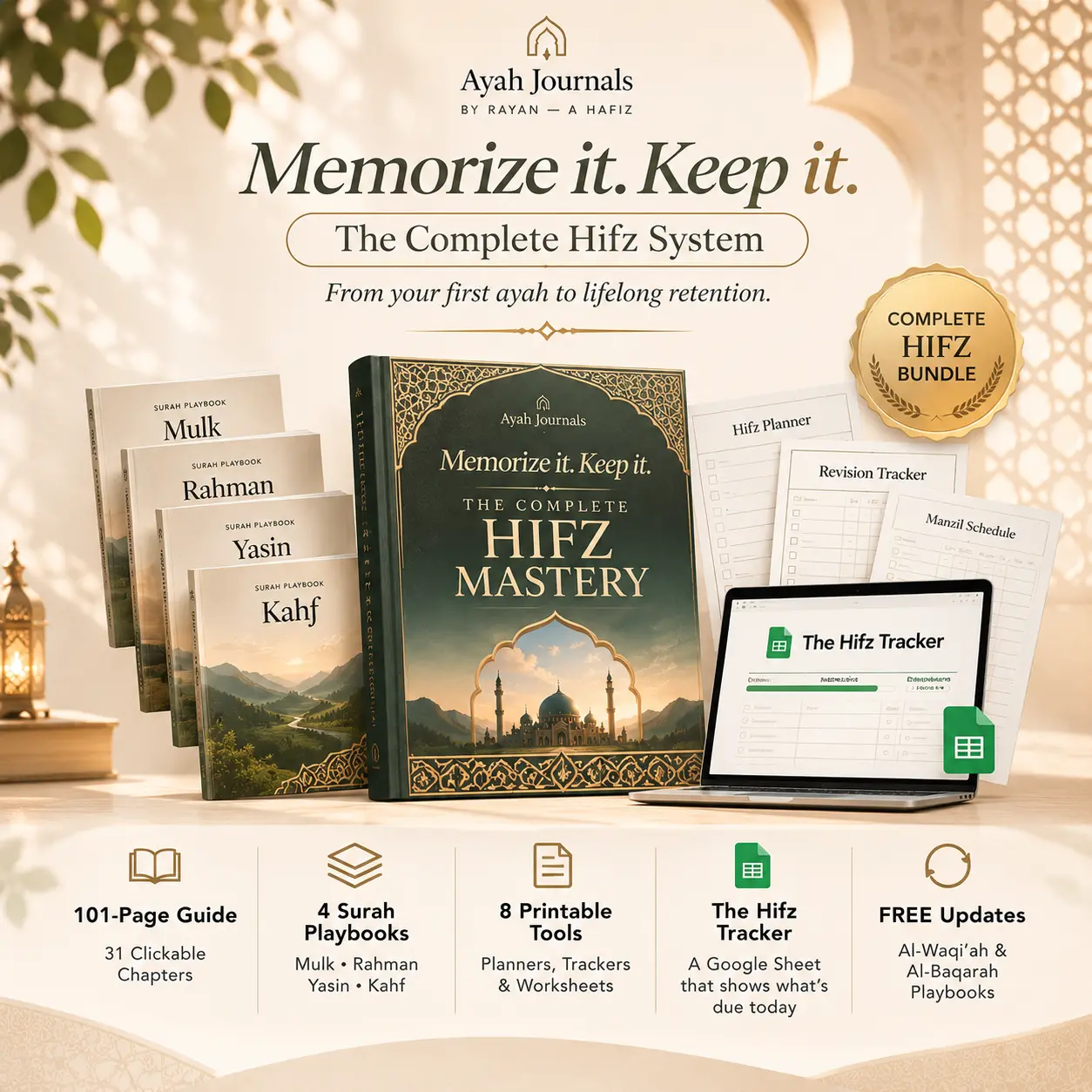
One system, built for a life that's already full: see what's inside Memorize It. Keep It.
Where to start this week
Pick a short surah you'll use in Salah. Surah Al-Mulk is an ideal first surah: 30 ayat, a clear flow of ideas, and many people already recite it every night. Here's a day-by-day plan for Al-Mulk.
Frequently asked questions
Is it too late to memorize the Quran as an adult?
No. Adults usually have less free time and less raw memory for repetition than children, but they have better understanding, focus and planning. A system built around those strengths works. And the Prophet ﷺ said the one who struggles with the Quran gets two rewards (Bukhari 4937, Muslim 798).
How much time does an adult need each day for Hifz?
About 25 minutes of dedicated time plus revision inside your Salah is a workable routine for a busy adult. With under 20 minutes a day, do sabqi and 2–3 new lines on weekdays (about 10 minutes), keep your manzil in Salah, and catch up at the weekend.
Can I memorize the Quran without a teacher?
You can do most of the daily work alone, but you need one human checkpoint a week: a teacher, a Hafiz friend, a memorization partner or an online halaqah. Without someone listening, mistakes go unnoticed and harden. Recording yourself is a last resort, not a replacement.

I memorized the whole Qur'an by 14 in a Saudi madrasah, more than ten hours a day, through a routine that nearly broke in 2020. I wrote down the methods my sheikhs taught me in Memorize It. Keep It., the system I wish I'd had from day one. Read my story.